





We hear the term carbon monoxide talked about a lot when it comes to home safety. Carbon monoxide is a toxic gas that is colorless, odorless and tasteless and is a by-product of the combustion that occurs with your water heater, your furnace or any gas-burning appliance.
Whenever there’s combustion, there’s also the risk of carbon monoxide poisoning. There are many precautions you can take in order to protect your family and your home from a carbon monoxide leak.
Here are three common causes of a potential carbon monoxide leak in your home:
Cause #1: A Malfunction in a Gas-Burning Appliance
It’s crucial to maintain gas-burning appliances because if there’s a problem that causes incomplete combustion, carbon monoxide can be created.
Cause #2: Cracked Heat Exchanger
Your furnace’s heat exchanger is where the process of combustion occurs. The air from the furnace circulates around the outside of the heat exchanger. If there’s a crack in the exchanger, the air runs across the burner and causes incomplete combustion and, in turn, creates a carbon monoxide buildup.
Cause #3: Improper Ventilation for a Gas-Burning Appliance
Older appliances typically have poorer ventilation than newer units. Newer furnaces also have an auto-off switch that will shut the furnace off if it’s not venting properly. However, water heaters don’t have this feature and can be more likely to leak carbon monoxide.
Protect Your Home From a Carbon Monoxide Leak
As we all know, carbon monoxide is extremely dangerous. Keeping household appliances, like your furnace and water heater, well-serviced and well-maintained will help keep carbon monoxide levels in your home low. It’s also important to make sure you have proper ventilation for your gas appliances and a good carbon monoxide detector in your home.
The Centers for Disease Control (CDC) advises that every household install a carbon monoxide detector. Like with most commercial products, there are a lot of options to choose from. Detectors that plug into a wall outlet are a common option, but these detectors are often operating at only about 12 inches off the ground. Ideally, the detector would be at a person’s breathing level or around 5 feet high.
How to Test for Carbon Monoxide
The easiest way to see if there is carbon monoxide inside your home is with a carbon monoxide detector. Most detectors will start detecting carbon monoxide levels at 70 parts per million. Ninety parts per million is where you’re in the danger zone, leaving a small window for error.
We recommend purchasing a carbon monoxide detector that starts detecting and giving alerts of carbon monoxide at 5 parts per million. The detectors should be placed in key areas of a house such as the living room, hallways and bedrooms.
You can also have a private company come to your home and perform indoor air quality tests that include carbon monoxide testing. These types of tests go beyond a household CO detector and are conducted using an electronic portable toxic multi-gas monitor, which can be calibrated to detect trace amounts of carbon monoxide. For more information on the carbon monoxide detectors sold by Bell Brothers, visit our website or give us a call at 515-337-2456.

Spring is a popular time to buy a home. Homebuyers are hoping to find their dream home — perfect location, updated finishes, maybe even a white picket fence. One thing that doesn’t typically make the top of the list — but should — is an updated heating and air conditioning system.
A home inspection is pretty standard before signing on the dotted line. Some problems are obvious, such as missing roof shingles or water damage, but it takes a specially trained eye to catch and diagnose issues with the HVAC system.
Related article: Buying a house? Ask these questions about the HVAC system
Nothing can rain on a new homeowner’s parade like having an HVAC problem shortly after purchasing their house that requires a costly repair or system replacement. A professional HVAC inspection costs less than $100 and will help homebuyers make an informed buying — or negotiating — decision.
What a professional HVAC inspection Includes
When a homeowner or buyer schedules an HVAC inspection with one of our technicians, there are a couple of key things we make sure to check. First, we check the gas line and exhaust.
Then we run and test the HVAC system to make sure it’s still meeting the manufacturer’s specifications. We also inspect the heat exchanger, one of the most vital parts of a heating and cooling system. The heat exchanger is an expensive part to repair and replace, so it’s important to make sure it’s working properly.
We will also conduct an overall inspection of the system to determine if there has been a lot of service performed. Our service technicians can tell if an HVAC system has been a “problem child” by the number of new parts that have been installed.
Investing in a professional HVAC inspection is beneficial for both the homebuyer and the seller. If you are buying or selling a home and are interested in having an HVAC inspection performed, contact us online or by calling 515-244-8911.
Waukee homeowners looking for an energy-efficient comfort solution often find that a hybrid HVAC system is the best fit. Dan and Wanda, longtime Waukee residents, were beginning to experience technical problems with the 17-year-old heating and cooling system installed in their home. The HVAC system was nearing the end of its useful life and had also developed a refrigerant leak.
After weighing the option to repair the refrigerant leak or replace the HVAC system, Dan and Wanda decided the most cost-effective solution was to install a new system.
How a Hybrid HVAC System Improved Comfort for Waukee Homeowners
In order to select an HVAC system that was the best fit for Dan and Wanda’s style of home and their comfort needs, a Bell Brothers Home Comfort Consultant talked to the homeowners to learn what their comfort needs were and if they had been experiencing any issues with the current system.
Through this conversation Bell Brothers learned that Dan and Wanda were dissatisfied with the level of comfort on the second floor of their home, especially in the master bedroom and bathroom. The house had been designed with two HVAC systems, but when it was built the developer only installed one system.
In addition, the master suite is located over the top of the garage, which is an unconditioned space, making it difficult to get proper airflow into that part of the house. In the winter the floors in the master bathroom were cold and in the summer the master suite was hot. What Dan and Wanda were experiencing is a common problem for many homeowners in Des Moines who live in a two story home.
Bell Brothers went to work on a solution that would address Dan and Wanda’s desire to make their master suite more comfortable.
Why a Traditional HVAC Zone System Wasn’t the Right Fit
In the past, a common way to address the type of problem Dan and Wanda were experiencing was to install a zone system. Installing a zone system requires additional duct work to be run in the house, and in many situations is not a feasible solution. This was the case for Dan and Wanda as well. Installing a zone system in their home would have required a major construction project in order to run the duct work and would have been cost prohibitive.
The Hybrid Inverter System: A Smart, Cost-Effective HVAC Upgrade
Bell Brothers compared a couple of solutions, including a traditional unitary system replacement with zoning and a stand-alone duct-free mini split system. Bell Brothers was able to solve Dan and Wanda’s comfort problem and save them money by offering a hybrid HVAC system for Waukee homeowners that requires installing only one unit instead of two. Because of advancements in technology, Bell Brothers was able to provide Dan and Wanda with an HVAC system that combines a traditional unitary system with a duct-free mini split system.
Bell Brothers started the replacement project by replacing Dan and Wanda’s failing HVAC system with a new outdoor heat pump system. The next step was to install the new air handling system in the attic. Duct work was added in the attic, as well as small refrigeration lines that went from the air-handling unit in the attic to the heat pump outside.
Providing Additional Comfort Control
Most homeowners have one thermostat on their main floor. In order to get more airflow upstairs, it is not uncommon for a homeowner to turn the main floor thermostat down. This causes the temperature on the main floor to be uncomfortable in order for the second floor to be more comfortable.
To ensure that this didn’t happen to Dan and Wanda, a second thermostat was added to the master bedroom to provide independent control of their main floor and second floor. Dan and Wanda use the thermostat in their master suite to control the duct-free mini split system. And the thermostat on their main floor controls the temperature on the main level.
Improving Comfort Control With Dual Thermostats
Dan and Wanda are thrilled with their new HVAC system. The solution Bell Brothers provided is less expensive than the traditional zone system, which can run up to $30,000. In addition, the duct-free mini split system is highly efficient, and very quiet.
If you’re interested in learning more about how a hybrid HVAC system for Waukee homes or another HVAC system can help meet your comfort needs, contact a Bell Brothers Home Comfort Specialist by contacting us online.
Schedule Online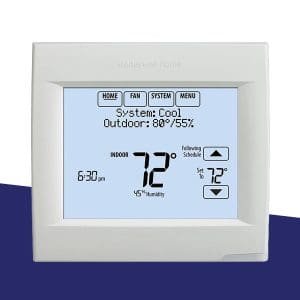
Your HVAC system is only as powerful as the thermostat that controls it. If you recently upgraded your heating and cooling system or you still have a manual thermostat in your home, it is a good idea to consider upgrading to a programmable thermostat.
With so many options available, it can be hard for homeowners to know which programmable thermostat to purchase. We recommend homeowners evaluate which features best fit their lifestyle. To help homeowners do this, we are sharing some key features of programmable thermostats.
The Best Programmable Thermostat
- Programmable temperature. Every programmable thermostat allows you to set different heating and cooling schedules. What you should pay attention to is how many different schedules can be set. Some programmable thermostats will let you set a temperature schedule for every day of the week, while others only allow one schedule for weekdays and one for weekends. There are also models available that allow you to set different temperatures for specific times of day, days of the week and multiple rooms in your house.
- Wi-Fi accessibility. A smart thermostat that connects to Wi-Fi allows you to control your thermostat via a smartphone, tablet or laptop. This feature is great when you are out of town and need to change your temperature settings because the weather changes drastically or your travel plans change unexpectedly.
- 24/7 troubleshooting. A smart thermostat can also create a link between your home and your preferred HVAC service provider. If there is an issue with your heating or cooling system — or it stops working completely — your smart thermostat will send you and your HVAC service provider an alert.
- Modern display and controls. Another feature to think about is the thermostat’s display. Some thermostats have large backlit displays and intuitive touchscreen capabilities to make it easier for users to see and adjust settings. Some models will also come equipped with voice activation controls.
- Compatibility. Unfortunately, not every programmable thermostat will be compatible with your HVAC system or your internet provider. Be sure to check the compatibility requirements before making a purchase.
Which Programmable Thermostat is Right for Your Home?
If you enjoy technology and have a busy lifestyle, a smart thermostat with Wi-Fi accessibility might be the right choice for you. If all the bells and whistles and advanced programming options are not important to you, a more standard programmable thermostat could be the best option.
Either way, it’s important to do your research before purchasing a new programmable thermostat. If you’ve read this blog post, you’re off to a great start. Have questions? Contact us today. Our team at Bell Brothers would be happy to discuss which programmable thermostat would be best for your home, lifestyle and comfort needs.
Bell Brothers is committed to training the next generation, and we added a state-of-art HVAC apprenticeship training facility in 2012. Listen as Chuck Gassmann shares why apprenticeship training programs are vital to help fill more than 100,000 HVAC technician jobs by 2025.
See all the advantages of a career with Bell Brothers — including no college debt!
You’ve heard about apprenticeship training, but what exactly does it entail? Watch the video below to see Chuck Gassmann explain the apprenticeship process and what you will learn in the training program.
Contact us today to learn more about the apprenticeship training program!
Did you know? The starting salary for an HVAC service technician is higher than many of those for young adults with a college degree. The skilled trades provide a great career opportunity for bright young men and women who like technology, working with their hands and want to make a difference in others lives. Watch the video below to learn more.
See all the advantages of a career with Bell Brothers — including no college debt!